

The premise
Token launches are visual events. A coin doesn’t just “go up” — it accelerates, breaks through, leaves a trail, attracts a crowd, then either explodes or burns out. You can see that. A list cannot. Every Solana trading tool today renders the market as a table. Rows of mint addresses, columns of percent-change. The interface throws away every cue our visual system is good at: motion, trajectory, density, formation, contrast. The Pump Zone exists because we asked one question: what would it look like if a feed could actually breathe?Open the live Pump Zone scanner
See Dequan’s spatial Solana token feed in the live terminal.
The mental model
The Pump Zone is a live field. Tokens are objects on the field. Their position is meaningful. Their motion is meaningful.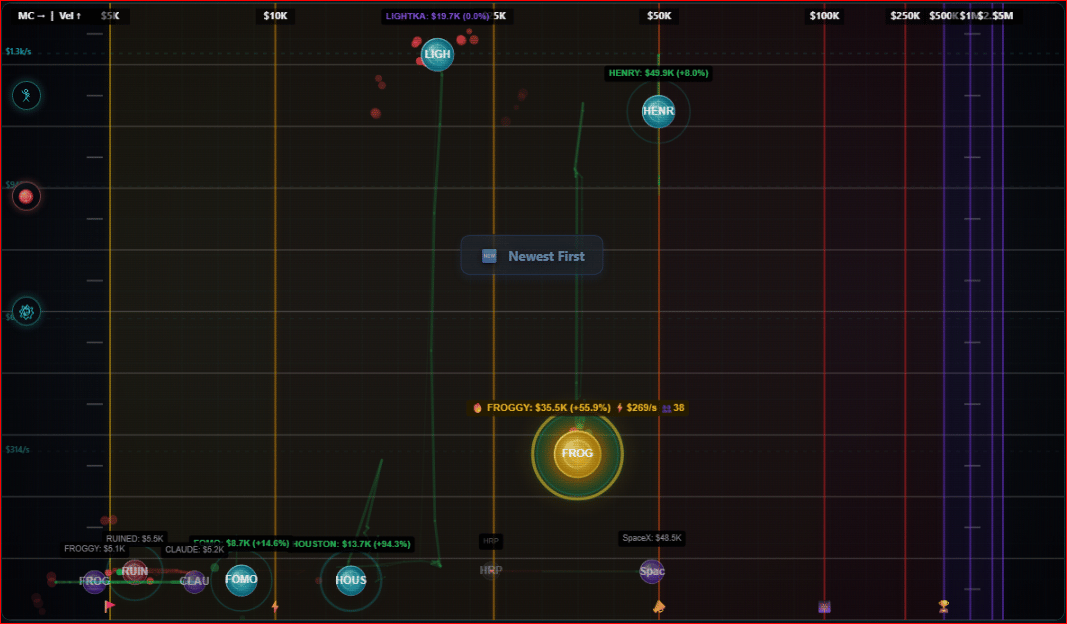
- Horizontal position = market cap. Newly created tokens enter from the left. Maturing tokens drift right.
- Vertical position = velocity. Fast climbers rise. Cooling tokens sink.
- Glow & motion = life. A flash means a fresh trade hit. A glide means the token is moving through MC space.
Velocity bands
The vertical axis isn’t just continuous — it’s banded into four kinetic states:Awakening
Just stirring. First buyers arriving. Almost-zero velocity but trending positive.
Building
Steady climb. Sustained green ticks. Real momentum forming.
Pumping
Rapid acceleration. Crowd notices. Volatility rising.
Mooning
Explosive vertical move. Often unsustainable, often the trade.
What’s on the field
Milestone markers
Field markers at meaningful market caps (5K, 10K, 50K, 100K, 500K). When a token crosses a marker, you see it cross — visibly. Crossing 100K MC for the first time is a real event, and it looks like one.
Inline micro-history
In the Pump Zone, every token carries a tiny sparkline of recent candles. You can read the trend without opening a chart. The Pump Zone gives you “is this real?” at a glance.
The Leaderboard strip
A horizontal ribbon above the field surfaces the top movers right now — ranked by recent velocity, volume, or magnitude depending on your sort. Click any leader to lock the field onto it.
Spotlight picks
Algorithmic highlights that the system thinks deserve a closer look — based on signal cluster, not paid promotion. Spotlights are surfaced with a cyan ring on the field and at the top of the leaderboard.
Candle Chart
Tap any token and the candle drawer overlayed with: the live candle chart, token metrics and buy amount presets. The drawer is where you buy, watch the candles, and sell — all in one surface.
Why the Pump Zone is faster than a list
A sorted list rerenders top-to-bottom on every update. Tokens have to travel from rank 47 to rank 3 over multiple frames before you’d ever see it. Your eye is reading noise, not signals. The Pump Zone doesn’t sort. It places. A token doesn’t “rise to rank 3” — it rises visibly, in real space, on the same frame the trade hit our edge. Tokens in the Pump Zone don’t have to rise in rank to be noticed. Dequan can render the entire active market enabling you to see recognizable patterns at a glance.Where it goes from here
The Pump Zone is not just a feed view — it’s the surface for everything else Dequan does:Spatial feed deep-dive
Why position is meaningful, how the field zooms, and how to read formations.
Velocity & momentum signals
The kinetic state machine, acceleration, and the gold velocity line.
ML Momentum Engine
A self-training ML model ranks every token by live pump probability. Unique to the Pump Zone.
Open a chart and trade
Tap a token, the candle drawer opens, and you buy and exit from the same surface.